Dynamic Funding Model for Social Enterprises and Community Projects
The Dynamic Funding Model
A smarter approach to financing community projects.
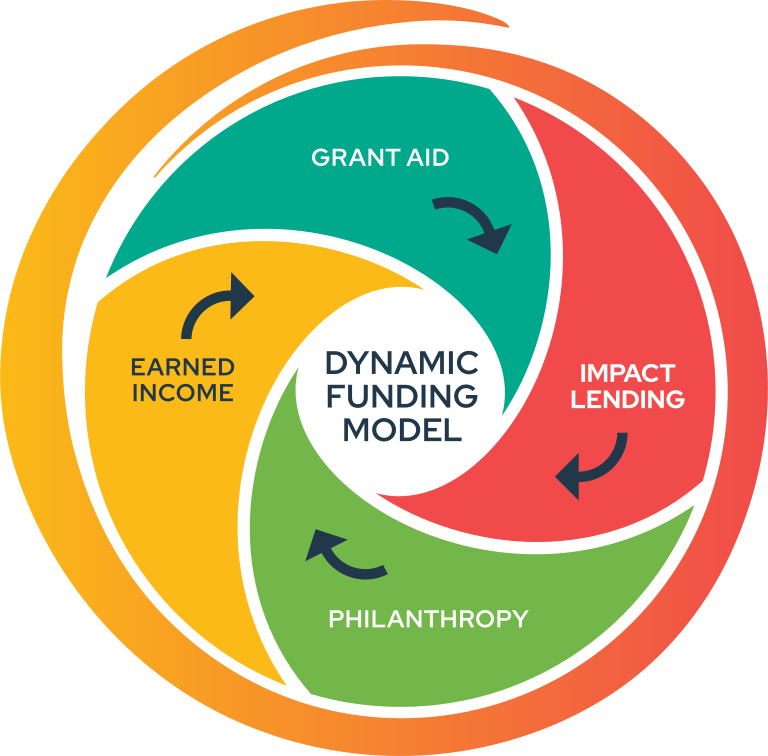
Sustainable community projects rarely rely on one source of funding. They require a carefully considered combination of grant aid, impact lending, philanthropy and earned income.
Clann Credo's Dynamic Funding Model brings these four funding pillars together, helping community organisations and social enterprises develop a funding strategy that reflects their ambitions, financial circumstances and long-term sustainability.
By matching the right type of funding to the right purpose and stage of development, organisations can bridge funding gaps, manage financial risk, strengthen their income base and deliver projects that create lasting social impact. Clann Credo’s key customer facing role is to advise community organisations how impact lending can support their financial model.
1. Grant Aid
Establishing The Foundation
Grant funding is often essential to getting community projects started. It can provide capital for facilities, services and activities that generate significant social benefit but may not produce sufficient income to cover their full cost.
However, grants may not cover the entire project cost and can be subject to conditions, restrictions and payment delays. This can create funding and cash-flow gaps that prevent projects from progressing.
2. Impact Lending
Unlocking Progress
Impact lending provides fair and flexible loan finance to help community organisations progress projects and address funding gaps.
Bridging loans can provide the finance needed to pay suppliers and contractors while organisations await approved grant payments. Term loans can provide additional capital for facilities, infrastructure and service development where grant funding alone is insufficient.
Clann Credo's role is to provide responsible finance that enables organisations to deliver their ambitions while maintaining the capacity to repay.
3. Philanthropy
Adding Flexibility and Opportunity
Philanthropic funding from trusts, foundations, businesses and individual donors can provide valuable additional resources.
It can support activities that are difficult to finance through borrowing alone, contribute to capital projects and provide the flexibility to develop innovative approaches.
4. Earned Income
Building Sustainability
Earned income is fundamental to the long-term sustainability of many community organisations and social enterprises.
Income generated through memberships, services, facilities, trading activities and other activities can provide an ongoing revenue stream.
A sustainable income base will help organisations meet operating costs, maintain facilities, repay borrowing and reinvest in their social purpose.
Grant aid may provide the initial capital contribution, while impact lending enables a project to progress or bridges the gap between expenditure and grant payments. Philanthropy can provide additional resources and flexibility, while earned income supports the long-term operation and sustainability of the project.
The objective is not simply to secure funding from four different sources. It is to develop a coherent financial strategy in which each funding source has a clearly defined purpose.

We work alongside organisations to understand their ambitions, assess their funding requirements and structure appropriate loan finance.
Our role is to help communities make effective use of available funding, bridge financial gaps and develop projects that are financially responsible and sustainable over the long term.
Why a diverse funding model makes community projects stronger
Relying on a single source of funding leaves a community project exposed: if a grant is delayed, reduced or refused, the whole project can stall. The Dynamic Funding Model helps communities think beyond individual funding sources and build a funding strategy that matches the right type of funding to the right stage, manages risk and creates greater financial resilience.
It doesn’t simply help communities find money; it helps them think strategically about how their projects should be funded. It encourages communities to be ambitious, resourceful and financially aware, while staying firmly focused on their social purpose.
The result is more than a funding framework. It is a smarter approach to financing community projects, helping communities understand how the different funding pillars work together and turn good ideas into sustainable projects with lasting social impact.
“Once we understood how the different funding streams come together, everything became much clearer.”
Vincent Minnock, Chair, Ballycumber GAA
FAQs
Frequently asked questions about funding community projects
The Dynamic Funding Model is a framework from Clann Credo that helps community groups and social enterprises combine grant aid, impact lending, philanthropy and earned income, matching each type of funding to the right stage of a project.
The four pillars are grant aid (public funding), impact lending (bridging and term loans), philanthropy (support from trusts, foundations and local businesses) and earned income (revenue the organisation generates itself).
Yes. Many grants are paid only when a project, or a phase of it, is complete. A bridging loan provides the money to pay suppliers and progress the work in the meantime, and it is repaid when the grant arrives. Clann Credo provides bridging loans to community groups for this purpose.
A bridging loan is short-term finance that covers the wait for a grant payment and is repaid from that grant. A term loan provides additional funding where grants alone are not enough, and it is repaid over an agreed period, usually from earned income.
Earned income shows that a project has community support and an ongoing source of revenue. It is a key indicator of sustainability and of the organisation’s ability to repay a term loan over time.
Clann Credo lends to community groups and social enterprises in Ireland such as sports & recreation clubs, community facilities, social enterprise, centres family resource centres, co-operatives, social and sheltered housing.
Still have questions?
If you can’t find what you’re looking for, get in touch with our team. We’re always happy to help.