What Is Impact Lending
In simple terms, impact lending provides the capital needed to turn community ambition into action.
Finance that enables communities to turn ambition into action.
Impact lending is a form of finance that combines responsible lending with a commitment to positive social impact.
It provides capital to community and voluntary organisations and social enterprises undertaking projects that deliver meaningful benefits for people and communities.
Unlike lending approaches primarily focused on commercial financial returns, impact lending considers both the financial viability of a project and the social value it will create.
The objective is to make appropriate finance accessible to organisations that have the ambition and capacity to deliver positive change but may face barriers accessing traditional sources of finance.


What Is Impact Lending?
Impact lending is a form of lending designed specifically to support projects that deliver social benefit. It combines financial sustainability with measurable community impact, ensuring that organisations can both repay their loans and achieve meaningful outcomes for the communities they serve.
In simple terms, impact lending provides the capital needed to turn community ambition into action.
Why Impact Lending Exists
Community organisations often face a fundamental challenge: funding does not always arrive when it is needed and it rarely covers the full cost of delivering a project. Grants are essential but they are typically paid after work is completed or in stages, creating gaps that can delay or limit progress. Traditional lenders, on the other hand, may not fully understand the nature of community-led projects, placing greater emphasis on financial metrics than on social value. Impact lending exists to bridge this gap. It provides practical, accessible funding that reflects how community organisations actually operate, enabling them to move forward with confidence.
How Impact Lending Works in Practice
Impact lending is built around two core considerations: the strength of the project and its ability to deliver impact and the organisation’s capacity to repay the loan over time. This balanced approach allows community organisations to access funding that might otherwise be unavailable through traditional routes. For example, a community group developing a new facility may use impact lending finance to begin construction while waiting for grant payments. A social enterprise may use it to expand services, generate income and build long-term sustainability. The focus is always on enabling progress while supporting responsible financial management.
How Impact Lending Differs from Traditional Lending
Impact lending is not simply a loan with a different label. It is a distinct approach to funding, shaped by the realities of community development. Traditional lending is typically driven by financial return and risk assessment alone. Impact lending, by contrast, places equal weight on social impact, recognising the broader value that community projects deliver. It is also more flexible in structure, allowing repayment schedules and terms to reflect the income patterns and operational realities of community organisations. This makes Impact lending more accessible, more relevant, and ultimately more effective for the sectors it serves.
The Role of Impact Lending in Community Development
Impact lending plays a critical role in enabling communities to build and sustain essential services and infrastructure. It supports projects that might otherwise be delayed, scaled back, or not delivered at all. From sports facilities and childcare services to housing, healthcare, and enterprise centres, impact lending provides the financial foundation that allows these projects to move from idea to reality. Importantly, it also supports long-term sustainability. By encouraging a mix of funding sources and responsible financial planning, impact lending helps communities build resilience and reduce dependence on any single source of income.
Impact Lending as Part of a Wider Funding Model
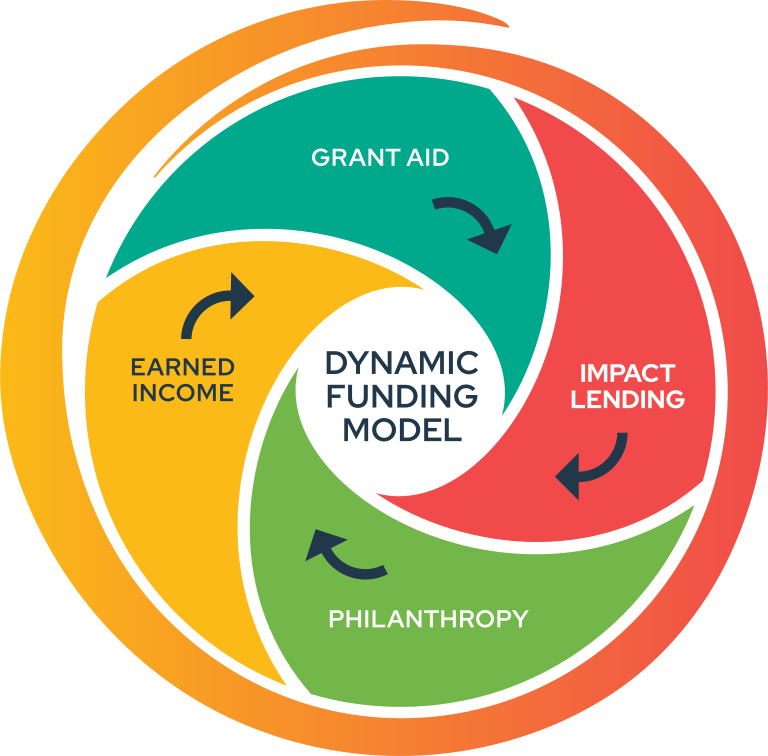
The most successful community projects do not rely on one source of funding alone. Instead, they combine multiple streams, including grant aid, earned income, philanthropy, and impact lending. Impact lending plays a central role within this model by providing the flexibility and working capital needed to connect these funding sources and keep projects moving. It is not a replacement for grants or fundraising, but a complementary tool that helps communities make the most of every available resource.
What is the Dynamic Funding Model for Social Enterprises and Community Projects
These four pillars work together, each playing a different role at different stages of a project’s journey.
Grant aid can provide the starting point, impact lending can bridge funding gaps and unlock progress, philanthropy can add flexibility and ambition, while earned income can support long-term sustainability.
1. Grant Aid
Public funding helps communities get projects off the ground. Typically, grant aid is not designed to meet the full cost or ambition of a project and tends to be paid when the project, or a phase of it, is completed. This can create both a funding gap and, often, a timing gap that communities need to bridge to keep their projects moving.
2. Impact Lending
Fair and flexible loans that bridge the gap between community ambition and available funding. A bridging loan can provide the finance needed to pay a supplier or progress work before grant aid is received. A term loan can provide additional finance where grant funding alone is not enough to realise the full potential or ambition of a project. This is Clann Credo’s primary role - and we are Ireland’s leading provider of fair, flexible bridging and term loans to community groups.
3. Philanthropy
A pillar gaining increasing focus and attention in recent years, philanthropy can provide more than financial support. The backing of a Trust, Foundation or local enterprise can deliver a critical injection of confidence - demonstrating that others believe in the project, its people and its potential.
4. Earned Income
A critical element of any community project or service for long-term sustainability, underpinned by community buy-in and a clear community mandate. Earned income provides community organisations with an ongoing source of revenue and is a key indicator of a project’s sustainability. It is also an important indicator of the organisation’s ability to service and repay additional impact lending over time.

Why Impact Lending Matters
Community organisations play an essential role in providing facilities, services and opportunities that strengthen society.
However, they frequently face challenges accessing finance.
Grant funding is a critical capital source but may be insufficient to meet the full cost of a project or may only be paid once work has been completed. Traditional commercial lenders may not always fully recognise the funding structures, income patterns and social value associated with community-led projects.
Impact lending helps address these challenges by providing appropriately structured finance that reflects the realities of community organisations.
It enables organisations to progress projects, manage funding gaps and invest in facilities and services that deliver lasting community benefit.
Financial Viability
A project must demonstrate a credible financial basis and the organisation must have a realistic capacity to repay its borrowing.
This involves understanding its financial position, income streams, expenditure, cash flow, funding commitments and longer-term sustainability.
Social Impact
We also consider the purpose of the project and the positive difference it will make.
This includes its contribution to community facilities, social inclusion, local development, essential services and opportunities for people to participate in community life.
These considerations are assessed together. Our objective is to provide responsible finance that enables worthwhile projects to proceed while protecting the long-term financial sustainability of the organisation.
The Clann Credo Approach
At Clann Credo, impact lending is delivered through a relationship-led approach that combines professional financial expertise with a deep understanding of community development. We take the time to understand the organisation, its ambitions, the project it wishes to deliver and the financial circumstances in which it operates. We consider the social impact alongside the financial viability of each proposal, structuring finance around the project's requirements and the organisation's capacity to repay. Our objective is not simply to provideloans. It is to enable community organisations and social enterprises toprogress sustainable projects that make a meaningful difference.

At Clann Credo, impact lending is delivered through a relationship-led approach that combines financial expertise with deep understanding of the community and voluntary sector.
We work alongside community organisations to understand their ambitions, assess their projects, and structure funding in a way that supports both delivery and long-term sustainability.

Our focus is not simply on providing loans, but on enabling communities to succeed. This means being accessible, flexible, and responsive, while maintaining a clear commitment to responsible lending and measurable impact.
By doing so, we help communities across Ireland move forward with confidence and deliver projects that make a real difference.